Table of Contents
Passionflower
(Passiflora incarnata)
Common Names
Passion flower, Passion fruit,Passion vine, May pops, Jamaican honeysuckle, Apricot vine, Granadilla, Maracuja, Water lemon.
Latin Name Passiflora incarnata
Family Passifloraceae
Habitat Passiflora incarnata is one of approximately 550 plants belonging to the Passifloraceae family and the one commonly used in Western Herbalism. (United States Department of Agriculture, 2003) Other Passiflora spp are mainly vine like plants, however there are some shrubs and trees in the family, the majority of these are distributed in the USA, Mexico, Central and South America, however there are species in South Asia and Oceania. Passiflora incarnata originates in Southern America (Peru) and is common in the southern states of the USA growing prevalently from Virginia to Florida.
Passionflower tends to grow in disturbed areas notably thickets, untended roads, paddocks, river banks and rail tracks. It prefers well drained soil. Passionflower tends to prefer a good amount of sunlight, at least half the day, not growing well in shade or beneath the tree canopy. It prefers a more sheltered area, with support for it’s vines – i.e. a tree or trellis for support. In the right conditions it can cover the floors of thickets in a few days. Passionflower can tolerate occasionally wet and acid conditions, however prefers a more neutral soil and is drought tolerant. From a gardening perspective, slow deep watering into a mulched root base is the best was to get the most out of the blooms into a mulched root base. The plant is also cold tolerant, in colder climates it will die right back, however, in warmer climates some foliage will remain on the plant throughout the year.
Description
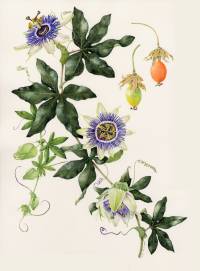
This is a rapid growing evergreen perennial vine plant, which climbs with multi trailing stems. Passionflower has an extensive root system, which sees the plant through winter. The passionflower has a pubescent or smooth cylindrical stem, although can be slightly angular when young. The stem is often long and trailing with many spring like tendrils. Passionflower’s leaves are a dull green in colour, they are 5-15cm in size, alternate and have between 3 and 5 lobes in a palmate formations, 3 lobed being more common. At the base of the blade of the petiole (the stalk that connects the leave to the stem) are two glands that secrete nectar. The flower has 10 whitish blue petals, with a white and purple corona, containing the stamen and sepals, arranged in a ring. These bloom mid summer onwards. The flower is often self sterile and often pollinated by insects such as bumble, honey and carpenter bees. However there are times when the plant has functional male and female reproductive parts as well as having only functional male parts. This aspect of having bisexual flowers is known as andromonoecy, it also regulates the amount of fruit on a vine. The flowers turn into green fruit, maturing to a more wrinkly brown ovoid fruit after approximately 3 months, these are roughly the size and shape of a hens egg. Insider the pulp of the fruit is white becoming yellow on maturity surrounding the many ripe black seeds that are approximately 5mm in size.
Cultivation
Seeds can be collected after the fruit has begun to wrinkle, planted or stored for use the following year. Passionflower can be tricky to grow from seeds, taking approximately 2-3 months for a seed to germinate, sometimes as a long as a year.
Seeds Use a mature seed from a fully developed fruit, plant immediately after picking (Autumn), otherwise spring due to the natural increase in germination and growth this time of year. Clean the seeds, soak them in water for 24 hours, seeds that float are not viable, only use those which have sank. Prepare seed pots with potting mix, gently misting the top, place the seeds onto the top of soil. Cover the pot with plastic bag to trap moisture. Place seeds outside of direct sunlight, ideally in a consistently warm space, await germination. When germinated, separate out into individual pots. Keep seedlings / young plants indoors or in the warm for first Winter. Harden off the plant for 2 weeks before moving outdoors and transplanting into a permanent positions.
Stem cutting These are best done in spring, this is the traditional time that many plants grow. Following the cold of winter the gradual increase in warmth, light and moisture due to the natural increased energy of the time of year. This means this is the most positive time to get a plant to germinate this way. Choose a 15cm stem cutting from a young part of the plant, a young shoot with leaf buds is ideal. Remove the leaves at the bottom of the stem cutting. Gently place the base of the cutting into a well drained potting / sand mix at a depth of approximately 5 cm deep, use a dibber to make the whole and dip the plant into willow water. Mist the potting mix and gently cover plant with plastic bag – air holes. Keep the plant warm but out of intense of direct sunlight, keep moist. It takes approximately 2 weeks to start taking root, once a good amount of roots are available, transplant.
Layering This techniques helps you grow another plant in the same location as the original as you are taking the new layer from there. The layered new plant is place in the ground and the mother original plant feeds it whilst it forms it’s root system. The best time of year to do this is late summer early autumn. The plant has just finished using it’s energy for fruit production, so it will have energy that can be used to form a new foot network for a layered plant.
Find a vine with a tip / end that will easily reach the ground. Gently remove leaves and nodes at the end of the vine, it is important to do this because vegetation left on can cause infection in the plant. Make a small trough in the soil and gently place the tip in, cover with soil. It may be a good idea to pin the plant tip in place with a garden peg or a stone to weigh the soil down. It takes 2 weeks to start to take root. When well rooted, when you gently tug the tip will stay in place. The plant to grow in situ or cut from other plant, dig up and transplant.
Parts of plant used Aerial – particularly the leaves as these are the richest in the active constituents.
Harvest Both the leaves and flowers are used as a herbal medicine. Pick both in the morning on a dry and sunny day during flowering / fruiting time. Leave some flowers for the pollinators and production of passion fruit. Place the leaves and flowers on a drying rack or draw in a cool dark room. The aerial parts can also be placed in a paper bag and left to hang in a cool dark room. It will take a couple of weeks to dry. Alternatively the leaves and flowers can be dried on the lowest setting of a dehydrator or on the bottom shelf of the oven, with the door slightly ajar with a towel draped over.
Symbology Passion flower received it’s name in the mid 1560s by a medical doctor from Seville a Dr. Nicolas Monardes. Dr Monardes was reported to be in solace in the Peruvian Andes following baring witness to some of the atrocities the conquistadors had inflicted on the indigenous people. Dr. Monardes reported seeing a vision Jesus Christ’s passion when he discovered the plant. The five anthers of the plant represented the five wounds of Christ. The white colour of the plant represented purity and the blue heaven and a calm existence. The more purple colour represents regal nature and strength. The 10 petals reflected the 10 true disciples of Christ, who did not betray him- lacking Judas Iscariot and Peter the denier. The lanceolate shape of the petals representing the lance that killed Christ. The tendrils represent the whips. The 3 stigma represented the 3 nails of the cross and passion flowers ovary represented the hammer. Lastly the corona of the plant with it’s purple filaments, this represented the crown of thorns Christ wore to his execution. These are the reasons that led to Dr. Monardes naming the plant Passionflower. Interestingly the BHMA (2024) state the plant was named by 17th century Jesuits in South America, it’s Italian name being “fiore della passione”
In Aztec symbology the plant is revered for the calming of the mind. Some native American tribes see it as a cure for insomnia and anxiety. Passionflower is also seen to represent the Sun in the Incan Empire. A legend from Brazil says the passion flower was created by the tears of a beautiful maiden when she was separated from her lover. https://foliagefriend.com/passion-flower-meaning/
The Passionflower is the state flower of Tennessee, the Cherokee naming it Ocoee, this is also the name of the local river and valley.
In Hinduism it is linked with Lord Vishnu and often used as an offering of worship to them.
From a Western cultural perspective the plant is again revered for the soothing effect on the mind and body. It also represents, peace, purity, serenity, intensity in love and often love for someone a long way away. The flower also, inner strength and guidance of the journey of love. Insects that feed from the Passionflower are seen as representing hope and care for delicate and fragile beings. Passion flowers are often added to Wedding bouquets.
Passionflower is linked in with the Goddess Venus and magic spells. Numerology links it with number 7 which is seen as the number of awakening, wisdom, intuition and good luck. The plant is also linked in with the astrological constellation Pisces. It’s medicinal and herbal properties helping to give a more calm and grounded perspective from the usually dreamy, artistic and compassionate traits of Pisces.
From a Spiritual perspective it’s vibrational rate links in and stimulates the 3rd eye (pineal gland) and the crown chakra, helping to heighten intuition and spiritual awareness.
Doctrine of Signatories The corona with its purple filaments has already symbolically been linked with Christ’s crown of thorns. Passionflower’s common use as a sedative to aid relaxation and sleep indicates the area this plant is working on – the brain and nervous system.
Perceptual Perspective Passionflower is reported to have a sweet smell similar to that of carnations. It’s taste is slight sweet and warm. Slightly cooling and drying, mildly bitter.
Constitution Passionflower seeds to sit in the mid range of constitutions being ever so slightly warm and dry. As it is more centrally placed this would denote a quicker reactivity time.
Active composition Flavinoids (0.8-2.5%) including apigenin, luteolin, iso-orientin, vitexin, schaftoside, rutin and chrysin. These support immune system with antioxidant and anti-inflammatory properties Alkaloids (0.1%) including norharman, harman, harmalol and harmol. These have sedative qualities Apoproteins – anxiolytic effect – anxiety reducing Also contains Chlorogenic acid, gynocardin, maltol, sterols and trace volatile oils (Fisher 2009)
Nutritional composition Vitamin A (beta carotenes) this is essential for eye health, immune function, reproductive function, liver function, skin health. and it plays a crucial role in maintaining various bodily functions. Vitamin A / beta carotenes may have an impact on the sleep-wake cycle as it effects the quality and duration of sleep. Vitamin C is an antioxidant vital in the reduction of free radicals, it supports the immune system, collagen production, adrenal tonic, skin health and the production of neurochemicals. Vitamin B3 or Niacin needed in the production of energy metabolism, neurological health, production of neurochemicall as well as being essential in cellular health. Vitamin B6 essential for neurological development and function, the production of neurotransmitters – serotonin, melatonin, dopamine histamine, production of stress and reproductive hormones. Folate or Vitamin B9 essential for RNA, DNA and protein synthesis and repair, promoting proper cell division, and preventing neural tube defects during pregnancy, blood health (anaemia) cardiac health. Research indicates Folate improve sleep. Magnesium know for its ability to relax muscles, improve nerve function, support bone health and regulate energy production. Low levels of Magnesium are linked with poor sleep maintenance and early morning waking. Calcium whilst commonly known for it’s role in supporting the skeleton is also needed to aid in the contraction of muscles including the heart. Calcium is needed for nerve signal in the brain and nervous system. Poor sleep onset is also linked with low levels of Calcium. Phosphorus similarly to Calcium is important for bone and dental health, blood clotting, muscle function, and energy metabolism Potassium regulates fluid balance, muscle contractions, and nerve signals, this also supports to heart health.
Actions / Properties Anodyne Anxiolytic Anti-spasmodic Antidepressant Hynotic Hypotensive Nervine Sedative – these are linked with the propertues of the alkaloids and the actions of various nutrients such as vitamin B3, 6, 9, C, Mg and Ca, which are required to make serotonin and melatonin, therefore support mood and sleep problems. Passiflora is also has monoamine oxidase inhibitor (MAOI) properties, slowing the breakdown of neutransmitters, therefore potentially increase the levels of serotonin and melatonin
One of the actions passionflower has is altering the levels of Gamma-amionbutyric acid (GABA) in the brain. GABA is an inhibitory neurotransmitter that calms the excited mind, aiding to relaxation
History This plant has been used historically for millennia in its its indigenous environment evidence showing it’s use between 8000-2000BCE. Ethnobotanists have reported archaeological evidence that passionflower was sited at human settlements, indicating it was a minor food source for the population.
This plant was listed in the US National Formulary until 1936
https://thesunlightexperiment.com/herb/passionflower
Science / Research There are approximately 550 flowering plants
Healing Qualities
Adverse Conditions
Interactions (Herbal and Medication – Positive and Negative) MAOIs Benzodiazepines, tricyclic antidepressants, opiods and hypnotics.
Methods of use (Supplements supportive of medication et al)
Dosage Tea infusion dried herb: 0.25-1g per cup of boiling water, infused for at least 10 minutes, up to three times a day. Tincture: 1:8 (45%) - 0.5-2ml t.d.s. (Fisher 2009) Fluid Extract 1:2 - 0.7ml-2ml t.d.s. (Phytomed 2024)
DIY tincture 1:2 95% fresh herb 2-4ml three times a day 1:5 50% freshly dried herb 2-4ml up to three times a day
Recipes
Meditation
References
- British Herbal Medicine Association (2024) Passion Flower, London, British Herbal Medicine Association. Available from https://bhma.info/indications/stress-and-anxiety/passion-flower/ (Accessed 24th March 2024),
- Fisher, C. (2009) Materia Medica of Western Herbs, New Zealand.
- Foliage Friends (2024) Passion Flower Meaning, Symbolism & Spiritual Significance Available from https://foliagefriend.com/passion-flower-meaning/ (Accessed 24th March 2024).
- Miroddi, M., Calapai, G., Navarra, M., Minciullo, P. L., & Gangemi, S. (2013). Passiflora incarnata L.: ethnopharmacology, clinical application, safety and evaluation of clinical trials. Journal of ethnopharmacology, 150(3), 791-804. Available at https://www.sciencedirect.com/science/article/abs/pii/S0378874113006983 (Accessed 24th March 2024).
- The Sunlight Experiment (2020) Passiflower (Passiflora incarnata) Available at https://thesunlightexperiment.com/herb/passionflower (Accessed 24th March 2024).
- United States Department of Agriculture (2003) Family Passifloraea Washington. United States Department of Agriculture.