Table of Contents
Yarrow
(Achillea millifolium)
Common Names
AchiUea, Allheal, Arrow Root, Bad man’s plaything, Bloodwort, Carpenters weed, Chimpmunk Tail, Death flower, Devil’s Nettle, Dog’s fennel, Dog’s nettle, Eerie, Field, Gearwe, Gordaldo, Gris, Hen milfoil, Hop, Herbal militaris, Hundred leaved grass, Knight’s milfoil, Knyghten, Kootenai, Little feather, Milfoil, Militaris, Military herb, Millefolium, Noble Yarrow, Nosebleed plant, Old Man’s Mustard, Old Man‘s Pepper, Plumajillo (Spanish), Sanguinary, Seven year love, Snake’s grass, Soldiers’ Woundwort, Sneezewort, Squirrel tail (Ojibwa), Soldier’s Woundwort, Staunch grass, Staunchweed. Thousand leaf, Thousand Seal, Thousand weed, Warrior Plant, Wound Wort, Ya Luo, Yarroway, Yerw.
Latin / Botanical Name
Achillea millefolium
Family
Asteraceae Previously Compositae, Aster or Daisy family
Etymology
The origins of the word Yarrow come from a corruption of the Anglo-Saxon plant name Gearwe and the Dutch name Yerw.
Yarrow was given the botanical name Achillea millefolium in 1753 by Carl Linnæus. This can be broken down to Achillea being linked to the name Achilles the famous Greek Hero reputed to of discovered the healing properties of Yarrow. Millifolium related to the appearance of the leaves having a 1000 - milli, leaves - follium. 1)
Habitat
Yarrow is originally a native plant to Europe, being found f as far as the Himalayas, Siberia, Iran and Caucasia. Yarrow also grows in North America growing from Alaska to Mexico. Yarrow is now found naturalised in many places around the world. Yarrow is often found on waste grounds, roadsides, meadows, slightly disturbed grass and soils and open forests. It prefers soil that is easy to crumble and alkaline / lime like in nature, growing from sea level to approximately 3,500m. Yarrow is drought and frost resistant and likes growing in a sunny position. Yarrow is generally pest resistant however can get aphids, spider mites and leaf hoppers. All of which can be treated with manual removal, soapy solution and need oil. 2).
Description
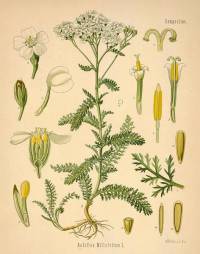
Yarrow is a semi-evergreen, erect, perennial plant that spreads through rhizomatous growth. Yarrow producing one to several stems are approximately 100cm tall, they are ribbed and striate and usually have a hairy like quality in the upper aspects of the plant. There is usually relatively little branching of stems other than the flowering heads (inflorescence). The name millefolium means thousand leaves, this describes the many leaves notable to yarrow, often described as having dense feathery leaves. A more detailed description would indicate the dense mats of short non flowering rosettes are often found at the base of the plant. These basal leaves are 5-20cm long and are larger petiolate shaped, slightly hairy with bi and tripinnate segments giving it’s feathery fern like appearance. The upper leaves smaller with similar structuring. The leaves grow spirally around the stem and are mainly found on the mid to lower part of the stem.
These are caulin and clasping. Yarrow inflorescence or flowers are composite flowers, these have between 4-9 involucral or phyllary which contain the corymbose penducles – the disk of very small tightly packed clusters of flowers. These are commonly white or pink flowers (wild) but can also be red, yellow and light purple. The flowers are ovate in shape and approximately 3mm in size, a small disk of flowers can have between 10 and 40 flowers present. These bloom from Spring to Autumn (March to October northern hemisphere and September to April southern hemisphere). The flowers attract many insects which pollinate them producing cypsela, small achene fruits. The plant has a strong aroma often likened to chrysanthemum, some people find the smell overpowering and irritating. The white flowers are the more medicinal. 3)
Ecology
Yarrow provides both pollen and nectar to a huge array of insects this include moths, bees, beetles, wasps and galls.
Cultivation
The best time to plant Yarrow is in the spring, after the last frosts. Ideally plant in full sun, that way the plant grows more compact with many more flowers, in partial shade and shade it can become straggly and lack flowers. Plant in ideally it’s soil, which is a crumbly well drained soil. Yarrow will tolerate clay but does tolerate wet feet, it prefers heat to grow well. If Yarrow grows in rich soil it tends to bolt and fall over, so may need staking, remember it naturally prefers waste grounds, often thriving there. When planting loosen the soil with a garden fork to approximately 45cm in depth, mixing in a 5-10cm layer of compost. Space plants approximately 30cm apart, if too close together they will not thrive. These plants will rapidly grow and spread in the right conditions.
Propagation is through planting seeds this can be done both indoors and outside, taking tip cuttings and root division.
Seed
If growing from seed either purchase from a reputable seller or acquire from a Yarrow plant in seed. Harvest during the summer months, the seeds will be in clusters and have begun to dry out turning a brown or grey. Cut the seed heads from the plant and place in a paper bag. Store this in a dry dark place, occasionally shaking the bag to separate the seeds from the seed heads. Prior to germination the seeds need to be scarified, this is when the hard outer shell of the seed is broken to allow the passage of moisture into the seed embryo. This can be done by making a placing the seeds between two pieces of fine grade sandpaper and gently and briefly rubbing the paper to make the cuts. Scarified seeds can be placed outside. Once this is done the seeds need to be stratified by placing them in a cold moist place, ideally they need to be left there for approximately a month. Then plant indoors.
Seed be aware that it takes 14-30 days to germinate. Scatter the seeds over the soil gently pressing them into the soil 1cm deep as the seeds are small. Cover with a fine layer of soil and / or vermiculture. For the seeds to germinate it is important to water the seeds, keeping the soil moist not waterlogged. Temperature also needs to be maintained between 15-21oC. Although the seeds take 2-3 weeks to germinate they often can take longer. To ensure a more successful germination start indoors and use heat pads to encourage growth. Seedlings can germinate earlier and then be transplanted outside when conditions are more suitable. 4)
Tip cutting
This is best done in spring. Using a sharp knife to make a clean cut of soft spring growth. Chose a point at the third or fourth leaf node from the tip of the plant, approximately 15 cm long. Make a diagonal cut, to ensure the most surface area for nutrient intake and root growth, Remove the lower leaves, encourage the cutting to root by using a rooting medium i.e. sitting in willow water for 15m. Place cuttings into potting medium i.e. seedling mix, mixture of vermiculite, perlite and coconut coir (more sustainable than peat moss). Water with willow water. Spray or water regularly keeping soil moist not water logged. Once there is evidence of new growth allow plant to establish then transplant into the garden. 5).
Root Division
After 3-5 years of growth the plants can be divided through root division. Remove any dead foliage and divide and replant. This is done in early spring or late autumn. The divided plant will replicate the traits of the original.
To care, each spring, surround the plants with a thin layer of compost. Even though this plant is drought tolerant it will need watering if there has been less than 3cm of rain in the week. By dead heading the flowers throughout summer encourages the plant to produce more flowers. 6).
Pests
Generally resistant to pest however can get aphids, spider mite and leafhoppers. These can be controlled by a number of methods, these include:-
- Manual removal, literally picking the pests off by hand.
- Insecticidal soap (castille soap) – a soap water solution which the this suffocates them.
- Neem oil which is a natural insecticide.
- Companion planting – Garlic Chrysanthemums and Marigolds all deter the pests. (Cultivating flora 2024).
Parts of Plant Used
The flowering part of the plant is generally used, however some use both the flowers and leaves. The root can and whole plant can be used and is often used in more traditional form of herbalism. 7).
Harvest
The flowers and leaves are harvested ideally on a dry day before noon. If the plant needs cleansing i.e. checking and removing bugs or debris, the be sure the lightly moisten and pat thoroughly dry. A wet plant significantly increased the risk of mold. Make small bunches of stems with leaves and flowers bunches together with string or a rubber band. Hang these in a cool dark location. Check every couple of days, however dependent of temperature and humidity it may take couple of weeks to dry. The feel and texture of the plant will feel slightly crumbly. Once dry chop or cut into small pieces and store in ideally a dark glass jar in a cool dark location.
Other methods of drying include hanging herbs in a paper bag, placing in herb hanging or drying trays, in a dark location. Quicker methods include using a hot water cupboard, oven on low setting door slightly ajar or a dehydrator on low temperature. 8)
Symbology, Folklore, Magic and Spiritual Associations
Yarrow also has a relationship love, the blooms of the flower being symbolic of true love and a relationship, often a marriage lasting for seven years – hence one of Yarrow’s other names Seven years love. Yarrow if often found in a brides bouquet or hung over the new couples marital bed as it’s symbol of true love. Interestingly Yarrow’s is also viewed as the treatment and cure for a broken heart, maybe it’s Yarrow’s abilities to support the cardiac system that also help in this area. Yarrow is also linked with the Goddess Venus who also rules the heart.
Yarrow has a number of links with psychic powers, magic and mysticism. Yarrow has been used in exorcisms, spells and incantations.
Astrologically Yarrow is also linked with the planet Venus as well as a correspondence to water. There is also an association with Yarrow having a more feminine persona.
Other deities Yarrow is link with are Cernous, Herne and Pan. 9).
Doctrine of Signatories
The multitude of fine leaves can give the appearance of knitting, showing what Yarrow supports the skin in doing, knitting back together.
The rhizomatic spread of roots shows an interconnection and community. 10).
Perceptual Perspective
Yarrow has an aromatic smell similar to chrysanthemum. It’s taste is that of an astringent, bitter, pungent smell and taste. 11).
Constitution
Yarrow can be perceived as having a a slightly warmer and dryer constitution more suitable for those with a more damp and cool constitution. 12).
Active composition
Due to the wide variety of geographical locations Yarrow lives in there will be a variation on the type and amount of constituents within it. Yarrow from a microbiological perspective has polyploidy, this is when there is are multiple sets of chromosomes beyond the usual set. With Yarrow it has diploid (2 sets), tetraploid (4 sets) ad hexaploid (6 sets). The hexaploid presentation being the more common form. The varying levels of chromosomes, the maturity of the plant, the variety of habits and growing conditions give Yarrow differing qualities in it’s active constituents. The main known active constituents are as follows:-
Volatile oils
These make up approximately 1.5% of the plants and are at their highest and most active level during the height of flowering season. The oil varies in colour from light to dark blue dependent on the content and quality. The volatile oils contain more than 60 volatile oils, on group of these are known as proazulenes, these included Chamazulene a blue – violet form of azulene, which is also found in Chamomile (Matricaria chamomilla) and Wormwood (Artemisia absinthium). If you have ever used German Chamomille essential oil you will note the blue colour of this – this is the Chamazulene component. This is mainly found in the tetraploid component which is rich in sesquiterpenes, the Chamazulene can be as much as 53% of this.
====Monoterpenes==== in the plant are also present, these increase relative to the sesquiterpenes and the plants age. Most Yarrow plants contain monoterpenes α and β pinene and sabinene. The oil from the hexaploid dominate plant contains linalool (26%) and camphor (18%), with lesser amounts of1,8-cineole, borneol and the other components. Other notable volatile oils (tetraploid) include β-bisabolene, α-bisabolol, δ-cadinene, β-caryophllene, trace amounts of thuja, eucalyptol and α-terpineol.
Sesquiterpene lactones
These include guaianolides achillicin (a prochamazulene) achillin, leucodin, the 8 derivatives of α-angeloxy, desacetylmatricarin, α-peroxyachifolids (up to 0.6% in flowers and 0.05% in leaves), achimillic acids A, B and C and germacranolides.
Bitters
Achilleine (glyco-alkaloid), stachydrine, choline and betaine
Tannins
The plant contains upto 4% tannins
Flavinoids
The plant contains between 0.5-1.8% flavinoids, these includefree aglycones, luteolin, centaureidin, the glucosides of these components and artemetin, casticin and rutin.
Cyanogenic glcosides
Sterols
These include β-sitosterol, campesterol, cholesterol, stigmasterol, triterpenes α- and β-amyrin psuedosteroltaraxasterol and taraxasterol.
Hydroxycoumarins
====Phenolic acids==== These include caffeic, salicylic and isocalerianic acids 13).
Nutritional composition
Vitamin A / beta carotenes - This is essential for eye health, immune function, reproductive function, liver function, skin health. and it plays a crucial role in maintaining various bodily functions. Vitamin A / beta carotenes may have an impact on the sleep-wake cycle as it effects the quality and duration of sleep.
Folate or Vitamin B9 - Essential for RNA, DNA and protein synthesis and repair, promoting proper cell division, and preventing neural tube defects during pregnancy, blood health (anaemia) cardiac health. Research indicates Folate improve sleep.
Vitamin C – This is an antioxidant vital in the reduction of free radicals, it supports the immune system, collagen production, adrenal tonic, skin health and the production of neurochemicals.
Vitamin E – This is a powerful antioxidant needed for the removal of free radicals. Supports the immune system, skin and reproductive health, supports vascular and heart health.
Vitamin K - Notable for supporting clotting on the blood, this will be linked into the styptic aspect of Yarrow.
Copper - Supports the cardiovascular system, nervous system, reproductive health.
Iodine - This is needed for the regulation of the thyroid which then regulates the rest of the body.
Iron - A wide range of function, notably in haemoglobin, where the iron molecule is part of oxygen transportation around the body.
Manganese - Supports the brain, nervous system, kidneys, liver, pancreatic and bone health.
Potassium - Linked in with cellular electrolyte balance, also really important for cardiac and vascular health 14).
Actions:
Antihaemorrhagic, Aniinflammatory, Antimicrobial, Antipyretic, Antiseptic, Antispasmodic, Astringent, Bitter tonic, Diaphoretic, Diffusive, Diuretic, Haemostatic (Styptic), Hypotensive,Peripheral vasodilator, Vulneray.
Historical Use:
Yarrow has been used for thousands of years. There are reports of Yarrow being found in the graves of both Neanderthal and early humans, In a cave in Shanidar, Iraq the pollen of Yarrow was found in 75 000year old Neanderthal graves. Pollen was sparse in soil samples with the cave but around the body 28 types of pollen were found,over these 7 types of pollen were found in clusters, suggesting flowers. Yarrow was one of the clustered group of herbs, the others also being medicinal herbs. This has lead researchers to question whether the Neanderthal used medicinal plants in the burial rites as possibly some form of sacred herb. 15).
Folk law reputes the druids used Yarrow stalks to do fortune and weather rituals, T=this is hard to ascertain as the druids were renown for having an oral history. It seems Yarrow stalks had a role in a number of cultures. In Europe during the Medieval period Yarrow stalks were used as a form of spirit invocation and banishment. Whilst in China Yarrow stalks were said to be the most accurate for predicting the divine messages of the I Ching or Yi Jing.
The name botanical name of Yarrow Achillea millefolium tells part of the story of yarrow. Achillea is linked to Achilles the hero of the Trojan war. Pliny the Elder attributed Yarrow’s wound healing qualities to have been discovered by Achilles, notably cloth of gold 16). Whereas Homer reported Achilles was taught by the great healer and Centaur Chiron, A number of stories report that Achilles used Yarrow to heal his soldiers wounds following battle. Hence Leong, M. 17) why Yarrow is also known as Soldiers’ woundwort and Allheal. A more mythological account states Yarrow sprang from gordaldo metal shards of Achiles spear, he then used these to cure Telephus’s wounds. One Greek myth spoke of Achilles using a Yarrow tincture to protect him from arrow strikes. Apparently he used the tincture to paint his whole body, except that of his heels and tendons. Another story tells of Achilles acknowledging the lack of Yarrow available to him when he received his mortal wound. There are other stories that report other herbs uses however the fact Yarrow has such historic doctrine indicates the knowledge and respect of this herbs and it’s healing qualities.
There are historical reports Roman as well as the Greeks soldiers using Yarrow to treat their injuries and wounds. One of the qualities of Yarrow is that it is a styptic, means it stops bleeding through it’s astringent nature, use of ointments and poultices was applied to battle wounds.
From a military perspective the plant represents bravery, particularly through war, this is acknowledge in the number of military names Yarrow has – Knight’s milfoil, Military herb and Soldiers’ woundwort. It is thought that soldiers / warriors wearing a sprig of yarrow gave them courage and protection, as well as be of help their wounds.
Yarrow in America has been used in a variety of ways by the Indigenous people notably the Klallam and Nuu-chah-nukth tribes. A root decoction was made to treat coughs, colds and respiratory conditions. Whilst other tribes would use an infusion of the whole plant to treat colds and sore throats. Another remedy being to chew leaves and swallow the juice. It has also been used to treat digestive disorders, particularly nausea, vomitting, diarrhoea, stomacic tonic and a general treatment for gastrointestinal disorders. 18).
Medicinal Uses
Integumentary System – Yarrow has been used to treat the skin for aeons. Some of it’s first uses relate to healing the skin. Dermatitis, Eczema, Chronic skin disorders, Bleeding, Wound management.
Gastrointestinal System – Yarrow being a powerful antiinflammatory and it’s healing action on skin tissue makes an excellent component of soothing and treating the digestive system. It is mainly used to treat acute and chronic dyspepsia, acute and chronic gastritis, anorexia, diarrhoea, general indigestion, internal bleeding and colic.
Cardiovascular system – Yarrow has a wide range of actions to support the heart of vascular system. It is noted in the British Herbal Pharmacopoeia that Yarrow is particularly effective for treating thrombotic conditions including hypertension notably for cerebral and coronary issues. Other cardiac system treatments Yarrow can be used for include fever, haemorrhoids (internal and external), hypertension, palpitations, phlebitis, varicose veins, varicose ulcers and venous stasis.
Interestingly Yarrow contains chemical that not only support the blood to clot but also to thin (Achilline / Coumarin).
Respiratory system – Due to it’s astrigent nature Yarrow can be used with any condition that produces catarrh. It is most commonly used for the following conditions – Asthma, Bronchitis, Colds, Influenza and Rhinitis.
Musculoskeletal system – Rheumatism.
Nervous system – Yarrow is known to produce a more relaxed mood, helping ease communication and easing stress and anxiety. Yarrow is particularly helpful for empathetic and sensitive in manner. The effect of Yarrow has been likened to Diazepam (Valium) a Benzodiazepine, also making it helpful for supporting people reducing valium levels. 19). High doses of Yarrow can cause perceptual changes and hallucinations in some people.
Reproductive system – Yarrow is a menstrual regulator so a useful herb to treat may women’s reproductive conditions. These include Amenorrhoea, Dysmenorrhoea (especially chronic), Leucorrhoea, Menorrhagia, Menstrual cycle regulation, Pelvic atonia.
Urinary system – The antimicrobial properties and tissue healing making it a choice for treating cystitis and urethritis. 20).
Adverse Conditions
This plant is known to cause contact dermatitis to people who are allergic to plants of the Asteraceae family. A good indication that there is a sensitivity if near or handling the plant you start to sneeze – hence the name Sneezewort. Yarrow is used in cosemetics but only at a maximum of 2% content, that way the is a significantly decreased risk of irritation and inflammation and no phytotoxicity.
A person who drank excessive amount experienced anticholinergic effects of burry vision, dry mouth, fatigue, and palipitation. 21)
Not recommended during pregnancy due to the Thujone content, impact of Yarrow on breastfeeding is unknown.
Interactions - Herbal Nutritioal and Medication – Positive and Negative Blood thinning medication – including antiinflammatories, anticoagulents, and antiplatlets notably aspirin, clopidogrel (Plavix), and warfarin (Coumadin) – concern Yarrow may increase bleeding time due to azulene content. Please note styptic qualities of Yarrow used for centuries. Medications that reduce stomach acid - Cimetidine (Tagamet), Famotidine (Pepcid), Ranitidine (Zantac), Esomeprazole (Nexium), OmeprazoleЛучшее (Prilosec), Lansoprazole (Prevacid) – Yarrow may increase stomach acid production Sedatives notably Anticonvulsants, - Phenytoin (Dilantin), Barbiturates, Benzodiazepines, such as alprazolam (Xanax) and diazepam (Valium), Drugs for insomnia, such as zolpidem (Ambien), zaleplon (Sonata), eszopiclone (Lunesta), ramelteon (Rozerem). Yarrow may cause excessive sedation. Lithium – Yarrow may increase the transition time to eliminate lithium in the body, this potentially is a serious condition, due to the potential for Lithium toxicity which can damage the renal system, notably the kidneys High doses of Thujone are toxic to the brain – Yarrow has minimal amounts of Thujone composition. 22).
Methods of use and dosage
Orally
Three times daily:-
Dried herb infusion 2-4g
Fresh herb infusion 4-8g
Tincture 1:5 (45%) 2-4ml
Fluid extract (25%) 1-2ml
Fluid extract 1:2 15-40ml per week
Topically Using the raw plant compressing and placing on a wound, or using for a nosebleed. (Fisher, C., 2009). Infused herbal oil – this can used.
There are historical reports Roman as well as the Greeks soldiers using Yarrow to treat their injuries and wounds. One of the qualities of Yarrow is that it is a styptic, means it stops bleeding through it’s astringent nature, use of ointments and poultices was applied to battle wounds.
From a military perspective the plant represents bravery, particularly through war, this is acknowledge in the number of military names Yarrow has – Knight’s milfoil, Military herb and Soldiers’ woundwort. It is thought that soldiers / warriors wearing a sprig of yarrow gave them courage and protection, as well as be of help their wounds.
Yarrow in America has been used in a variety of ways by the Indigenous people notably the Klallam and Nuu-chah-nukth tribes. A root decoction was made to treat coughs, colds and respiratory conditions. Whilst other tribes would use an infusion of the whole plant to treat colds and sore throats. Another remedy being to chew leaves and swallow the juice. It has also been used to treat digestive disorders, particularly nausea, vomitting, diarrhoea, stomacic tonic and a general treatment for gastrointestinal disorders. 23)
Medicinal Uses
Integumentary System – Yarrow has been used to treat the skin for aeons. Some of it’s first uses relate to healing the skin. Dermatitis, Eczema, Chronic skin disorders, Bleeding, Wound management.
Gastrointestinal System – Yarrow being a powerful antiinflammatory and it’s healing action on skin tissue makes an excellent component of soothing and treating the digestive system. It is mainly used to treat acute and chronic dyspepsia, acute and chronic gastritis, anorexia, diarrhoea, general indigestion, internal bleeding and colic
Cardiovascular system – Yarrow has a wide range of actions to support the heart of vascular system. It is noted in the British Herbal Pharmacopoeia that Yarrow is particularly effective for treating thrombotic conditions including hypertension notably for cerebral and coronary issues. Other cardiac system treatments Yarrow can be used for include fever, haemorrhoids (internal and external), hypertension, palpitations, phlebitis, varicose veins, varicose ulcers and venous stasis.
Interestingly Yarrow contains chemical that not only support the blood to clot but also to thin (Achilline / Coumarin)
Respiratory system – Due to it’s astrigent nature Yarrow can be used with any condition that produces catarrh. It is most commonly used for the following conditions – Asthma, Bronchitis, Colds, Influenza and Rhinitis.
Musculoskeletal system – Rheumatism
Nervous system – Yarrow is known to produce a more relaxed mood, helping ease communication and easing stress and anxiety. Yarrow is particularly helpful for empathetic and sensitive in manner. The effect of Yarrow has been likened to Diazepam (Valium) a Benzodiazepine, also making it helpful for supporting people reducing valium levels. (Price, 2020). High doses of Yarrow can cause perceptual changes and hallucinations in some people.
Reproductive system – Yarrow is a menstrual regulator so a useful herb to treat may women’s reproductive conditions. These include Amenorrhoea, Dysmenorrhoea (especially chronic), Leucorrhoea, Menorrhagia, Menstrual cycle regulation, Pelvic atonia.
Urinary system – The antimicrobial properties and tissue healing making it a choice for treating cystitis and urethritis. 24).
Adverse Conditions
This plant is known to cause contact dermatitis to people who are allergic to plants of the Asteraceae family. A good indication that there is a sensitivity if near or handling the plant you start to sneeze – hence the name Sneezewort. Yarrow is used in cosemetics but only at a maximum of 2% content, that way the is a significantly decreased risk of irritation and inflammation and no phytotoxicity.
A person who drank excessive amount experienced anticholinergic effects of burry vision, dry mouth, fatigue, and palipitation. 25)
Not recommended during pregnancy due to the Thujone content, impact of Yarrow on breastfeeding is unknow.
====Interactions==== Herb not to be made into a salve, balm or some other topical item.
Science / Research
Green Med info 26)
Integumentary Yarrow promotes skin resurfacing and improves the appearance of wrinkles and pores. 27)
These results suggest that Achillea millefolium could be a useful candidate for atopic dermatitis treatment. 28)
Reproductive health A millefolium is effective in minimizing the pain severity in primary dysmenorrhea. 29).
Achillea millefolium and Hypericum perforatum ointments reduce perineal pain level, redness, edema and ecchymosis of episiotomy wound. 30)
Immune system Shahani et al. 31) found that Yarrow had protective qualities against Ionising Radiation against lymphocytes (white blood cells) taken from peripheral blood samples. The whole blood was exposed to 2.5Gy of X-rays and then incubated with methanolic (alcoholic) extracts of Yarrow, these samples were at different strengths. Lymphocytes were prepared through mitogenic stimulation culturing (cell division - mitosis / reproduction) which would allow observation to determine the effect the radiation had on the micronucleus of the cells. This is when cells do not divide properly and leave a micronucleus outside of the daughter cell or contain 2 nuclei (binucleated). It was found that the antioxidants in the Yarrow sample provided a level of protection against ionising radiation, the maximum protection and decrease in cell nuclear abnormalities being 200 μg/mL.
Recipes
Topical skin support
- 80mls of Sweet Almond oil / Olive oil infused with Yarrow (Achillea millifolium) and Calendula (Calendula officinalis)
- 20g of bee wax
- 1ml Vitamin E oil * Unordered List Item
Heat in a bain marie melting the bees wax at a low temperature Add vitamin E oil – preservative alternative is heating a sprig of rosemary in the mix Pour into jars ideally brown glass and let set You can store this in the fridge it well help it last a little longer. Generally lasts 6-12 months Apply as needed.
Digestive Support Tea Equal parts
- Yarrow (Achillea millefolium)
- Calendula (Calendula officinalis)
- Plantain (Plantagi lanceolata)
- Chamomile (Matricaria chamomilla)
- Agrimony (Agrimonia eupatoria)
- Marshmallow (Althea officinalis)
- Ginger (Zingiber officinale) - 1/5 of the amount of the others
Support digestion and synergist Infuse up to 3 teaspoons in a cup of boiling water for 10 minutes, strain if required and add a little honey to taste is needed.
Reproductive Support Equal parts
- Yarrow (Achillea millifolium)
- Raspberry Leaf (Rubus ideaus)
2 teaspoons infused in a cups of boiling water for 10 minute, 3 times a day.
Fever Equal parts of
- Yarrow (Achillea millifolium)
- Chamomile (Matricaria chamomilla)
- Elder (Sambucus Nigra)
- Ginger (Zingiber officinale)
References
- Braun, L. and Cohen, M. (2015) Herbs and Natural Supplements - An evidence based guide, Volumes 1 and 2 4th edition, Chatswood: Elsevier.
- Corbett, S. (2019) Yarrow: Myth, Magic, and Medicine Available at https://www.rowanandsage.com/blog/2019/12/6/plant-profile-yarrow (Accessed on 18th Aptil 2024)
- Cultivating flora (2024) What are the little bugs on my Yarrow plant Available at https://cultivatingflora.com/what-are-the-little-bugs-on-my-yarrow-plant/ (Accessed 26th April 2024)
- De Sousa DP, de Almeida Soares Hocayen P, Andrade LN, Andreatini R.(2015) A Systematic Review of the Anxiolytic-Like Effects of Essential Oils in Animal Models. Molecules (Basel, Switzerland). 2015;20(10):18620-18660. doi:10.3390/molecules201018620
- Dogan NO, Cevik Y, Pamukcu Gunaydin G. (2015) An Unexpected Anticholinergic Effect due to Yarrow (Achillea millefolium). Journal of Academic Emergency Medicine Case Reports. 2013;4(3):89-91. doi:10.5505/jaemcr.2013.55477
- European Medicines Agency (2020) Yarrow Herb Achilea millefolium L., herba. Available at https://www.ema.europa.eu/en/medicines/herbal/millefolii-herba (Accessed 30th April 2024)
- Fisher, C., (2009) Materia Medica of Western Herbs. Nelson: Fisher.
- Franklin, A and Lavender, Susan (1995) Herb Craft: A Guide to the Shamanic and Ritual Use of Herbs Capall Bann Pub, Milverton.
- Grieve, S.E.M. (1931) A Modern Herbal: The Medicinal, Culinary, Cosmetic, and Economic Properties, Cultivation, and Folklore of Herbs, Grasses, Fungi, Shrubs, and Trees with All Their Modern Scientific Uses Harcourt Brqce, London.
- Hajhashemi, M., Ghanbari, Z., Movahedi, M., Rafieian, M., Keivani, A., & Haghollahi, F. (2018). The effect of Achillea millefolium and Hypericum perforatum ointments on episiotomy wound healing in primiparous women. The journal of maternal-fetal & neonatal medicine : the official journal of the European Association of Perinatal Medicine, the Federation of Asia and Oceania Perinatal Societies, the International Society of Perinatal Obstetricians, 31(1), 63–69. https://doi.org/10.1080/14767058.2016.1275549
- Herbal Pioneer (2024) Yarrow Achillea millefolium Available from https://herbalpioneer.com/yarrow-achillea-millefolium-monograph/ (Accessed 11th April 2024)
- Herb Federation of New Zealand (2024) Yarrow Achillea millefolium Available from https://herbs.org.nz/herbs/yarrow/ (Accessed 12th April 2024)
- Hopman E. The Signatures of Plants: Learning Nature’s Alphabet Available from https://wisdom.thealchemistskitchen.com/the-signatures-of-plants-learning-natures-alphabet/ (Accessed 10th April 2024)
- Jenabi, E., & Fereidoony, B. (2015). Effect of Achillea Millefolium on Relief of Primary Dysmenorrhea: A Double-Blind Randomized Clinical Trial. Journal of pediatric and adolescent gynecology, 28(5), 402–404. Available from https://doi.org/10.1016/j.jpag.2014.12.008 Accessed 21st April 2024
- Kloos, S., (2016) Yarrow and the Path of the Magician Available from https://forestmedicine.net/ecological-intelligence-blog/2017/3/21/yarrow (Accessed 1st May 2024)
- Leong, M. (2023) Growing Yarrow: A Step-By-Step Guide To Growing From Seed Available from https://shuncy.com/article/grow-yarrow-seed (Accessed 23rd March 2024)
- Malhi GS, Bell E, Outhred T, Berk M.(2020) Lithium therapy and its interactions. Aust Prescr. 2020;43(3):91-93. doi:10.18773/austprescr.2020.024
- Mount Sinai. (2024) Yarrow Achillea millefolium; Milfoil Available at https://www.mountsinai.org/health-library/herb/yarrow accessed 19th April 2024.
- Mount Pisgah Arboretum (2024) Achillea millefolium Available from https://mountpisgaharboretum.org/learn/plant-list/achillea-millefolium/ (Accessed 25th March 2024)
- Ngo, H. T. T., Hwang, E., Kang, H., Park, B., Seo, S. A., & Yi, T. H. (2020). Anti-inflammatory Effects of Achillea millefolium on Atopic Dermatitis-Like Skin Lesions in NC/Nga Mice. The American journal of Chinese medicine, 48(5), 1121–1140. https://doi.org/10.1142/S0192415X2050055X
- Pain, S., Altobelli, C., Boher, A., Cittadini, L., Favre-Mercuret, M., Gaillard, C., Sohm, B., Vogelgesang, B., & André-Frei, V. (2011). Surface rejuvenating effect of Achillea millefolium extract. International journal of cosmetic science, 33(6), 535–542. Available at https://pubmed.ncbi.nlm.nih.gov/21711463/ (Accessed 21st April 2024
- Painter, G. & Robertson, K., (1998) A Herbalist's Medicine Making Workbook. Revised ed. Oratia: s.n.
- Pelkonen O, Abass K, Wiesner J. (2013) Thujone and thujone-containing herbal medicinal and botanical products: Toxicological assessment. Regulatory Toxicology and Pharmacology. 2013;65(1):100-107. doi:10.1016/j.yrtph.2012.11.002]
- Price , A., (2020) Yarrow Uses for Wounds, Inflammation and Digestion Available from https://draxe.com/nutrition/yarrow/ (Accessed 30th April 2024).
- Schiller, N. (2023) How to grow and care for Yarrow Available from https://gardenerspath.com/plants/flowers/grow-yarrow/ (Accessed 23rd March 2024)
- Shahani, S., Rostamnezhad, M., Ghaffari-Rad, V., Ghasemi, A., Allahverdi Pourfallah, T., & Hosseinimehr, S. J. (2015). Radioprotective Effect of Achillea millefolium L Against Genotoxicity Induced by Ionizing Radiation in Human Normal Lymphocytes. Dose-response : a publication of International Hormesis Society, 13(1), 1559325815583761. https://doi.org/10.1177/1559325815583761
- Sommer JD. The Shanidar IV ‘Flower Burial’: a Re-evaluation of Neanderthal Burial Ritual (1999) Cambridge Archaeological Journal. 1999;9(1):127-129. doi:10.1017/S0959774300015249
- Thompson, K. (2024) Yarrow (Achillea millefolium) Available at https://www.herbrally.com/monographs/yarrow (Accessed 27th April 2024)
- Walcott, H. P. (2018) Yarrow: The Wounded Healer’s Herb Available from https://www.berkeleyherbalcenter.org/wp-content/uploads/2018/07/Yarrow-Monograph-HP-Walcott.pdf (Accessed 3rd April 2024)
- Whelan, R. (2024) Yarrow Available from https://rjwhelan.co.nz/herbs%20A-Z/yarrow.html (Accessed 27th April 2024).
- Wikipedia (2024) Achillea millefolium Available from https://en.wikipedia.org/wiki/Achillea_millefolium (Accessed 1st April 2024)
- Wood, M. (2023) The Doctrine of Signatures The Matthew Wood Institute of Herbalism. Available from https://www.matthewwoodinstituteofherbalism.com/pages/blog?p=the-doctrine-of-signatures (Access 28th March 2024)
- Wood, M. (2023) The Indispensable Blood Remedy Yarrow The Matthew Wood Institute of Herbalism. Available from https://www.matthewwoodinstituteofherbalism.com/pages/blog?p=the-indispensable-blood-remedy-yarrow (Access 28th March 2024)
- Yaniv, A., and Bachrach, U., “Handbook of Medicinal Plants”, Haworth Press, 2005.