
This is an old revision of the document!
Breath Work
Breathing exercises are a gentle way to help support your health and well-being as well as dealing with acute stressful situations. When we breathe we are meant to breath abdominally from the diaphragm. All too often during times of stress and illness we breath superficially and rapidly, usually breathing from our chest. Our breath is essential for life, therefore if we are unable to breath correctly, this can have a detrimental impact on our health. By being aware of our breathing and altering the way we breath we can have a positive impact on our health.
In yoga breathing exercises are called Pranayama, this word means “to extend the vital life force” this practice is also called prana. Vital life force is also called Chi or our conscious or energy being. Ideally it is best to do breathing exercises under the guidance of a tutor, however here are some really simple exercises to attempt at home. For the best effect practice for at least 5 minutes each day, you don’t get something for nothing, so you have to put the work in. Choose a regular time, i.e. waking up, before going to sleep – not after a heavy meal.
By doing slow, deep, abdominal breathing you are literally sending the signal to the brain, that you are in a safe place. This helps your nervous system move from the stressed sympathetic nervous system to the more relaxed parasympathetic nervous system. By doing this practice you can help to retrain your breathing.
Basic Breath Awareness
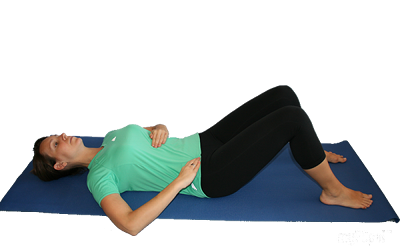 Introductory diaphragmatic breathing, this teaches you how to have more conscious awareness of your breathe and how to deepen this.
Benefits: Nervous system becomes more calm and quiet with practice, reducing stress, anxiety and improving self-awareness.
Practice: At least once a day.
How: Lie on your back making sure you feel comfortable, your knees are bent and feet flat on the floor approximately hip space apart. Put the palm of your hand on your abdomen and breathe comfortably for a moment, observe the quality of your breath. Does your breath feel tense regular, strained, uneven, shallow? What do you notice? Observe without any judgement. Then gradually make your breathing as balanced, relaxed and smooth as possible. Introduce a slight pause after each inhalation and exhalation.
Once the breath feels relaxed and comfortable, notice the movement of the body. As you inhale, the abdomen naturally expands; as you exhale, feel the slight contraction of the abdomen. In a gentle way try to actively expand the abdomen on the inhale and contract the abdomen on the exhale to support the natural movement of the diaphragm and experience the pleasure of giving yourself a full, relaxed breath. Continue the practice for 6 to 12 breaths.
Once you feel your breath is relaxed, notice the movement of your body in relation to the breath. As you inhale the abdomen expands gently, as you exhale it contracts. Gently encourage the expansion on inhalation and relaxation on exhalation, encouraging the natural movements of your body, experiencing full deep breathes. Practice for 6-12 breathes.
The Cooling Breath (Sitali Pranayama) Inhaling across the tongue has cooling and calming effect on the nervous system. To do this, you have to curl the sides of your tongue to make it look like a straw. Some people cannot do this, use the Hissing Breath (Sitkari Pranayama) as an alternative.
Benefits: Improve focus; decreases agitation, anger, and anxiety; and reduces heat.
Practice: Twice a day, or as needed during stressful times or if you feel sleepy.
How: Sitali Pranayama - Sit comfortably on a chair or on the floor, your shoulders relaxed and spine naturally straight. Lower the chin a little, curl the length of you tongue like a straw and project it out of your mouth a little way, make sure you are still comfortable. Gently inhale through the “straw” then slowly lift your chin toward the ceiling, not hyperextending the neck. At the end of the inhalation, with your chin raised, retract the tongue back into your mouth and close it. Gently exhale slowly through the nostrils and slowly lower your chin to a neutral position. Repeat for 8 to 12 breaths.
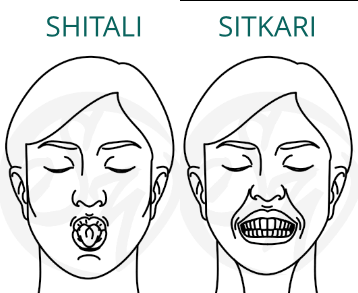 Sitkari Pranayama
Inhale through a slightly closed mouth, over the tongue and exhale through the nostrils as you slowly lower your chin back to neutral. Repeat for 8 to 12 breaths
Sitkari Pranayama
Inhale through a slightly closed mouth, over the tongue and exhale through the nostrils as you slowly lower your chin back to neutral. Repeat for 8 to 12 breaths
The Long Exhale This 1:2 breathing practice, this gradually increases your exhalation the aim being for it to be twice the length of of your inhalation.
Benefits: Can reduce insomnia, sleep disturbances, and anxiety, whilst relaxing of the nervous system.
Practice: At bedtime for support sleep, in the middle of the night when awake, or at any time of the day to calm stress. Ideally avoid The Long Exhale first thing in the morning, unless you're experiencing stress. The relaxing nature of the breath make it slightly more challenging to get on with your day.
How: Start by lying on your back, your knees bent and your feet flat on the floor a hips widths apart. Place the palm of your hand on your abdomen and take a few relaxed breaths, feeling the abdomen expand and contract with each on the inhalation and exhalation. Over several breaths count the length of each inhalation and exhalation. If your inhalation is longer than exhalation, make them the same length over the next few breaths. Once your inhalation and exhalation are equal,slowly lengthen your exhalation by 1 to 2 seconds, gently contracting your abdomen. Keeping the breath smooth and relaxed, gradually increase the exhalation by 1 to 2 seconds once every 2-3 breaths. Ensure you experience no strain as the exhalation increases, do this until your exhalation is double the length of the inhalation, but not beyond this. For example, you gently inhale for 4 seconds, do not increase the exhalation to more than 8 seconds.
Even if exhalation is only slightly longer than the inhalation, this can induce a calming effect, make sure you don't push yourself beyond your capacity. It may take a number of practices to do this. The caution here is that overexertion can push you pack into the stressed state making you feel anxious or agitated instead of calm.
If you are finding your breath feels uncomfortable or short, or if you're gasping and struggling, on the next inhalation, back off to a ratio that is gentle and do this for 8 to 12 breaths. Finish this exercise with 6 to 8 natural, relaxed breaths.