
Turkey Tail Mushrooms
Trametes versicolor
Common Names
Turkey Tail Mushrooms, Yin Zhi (cloud mushroom) – TCM, Kawaratake (room tile mushroom) – Japan.
Latin / Botanical Name
Trametes versicolor formerly Coriolus versicolor
Family
Polyporaceae.
Etymology
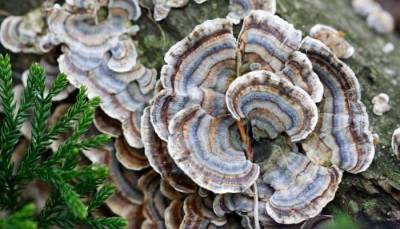
Turkey tail mushrooms are named because of how similar their appearance is to a turkey’s tail.
Habitat
Turkey tail mushrooms are common and found in temperate forrests around the world, notably Asia, Australasia, Europe and North America. They are realtively easy to find growing on dead and rotting wood of hardwood deciduous trees, such as dead trunks, branches and stumps, these can be in a rural or urban location.
Description
Turkey tail mushrooms are a type of bracket fungi, this is the fruit of the mushroom. It appears leaf / tongue / fan like in shape, often with wavy edges, due to forming circular structures. The is no stalk to the mushroom. The cap of the mushroom is flat and can be approximately 3mm thick, the whole mushroom being approximately 10cm in diameter. They are called turkey tail due to the similarity to a turkey’s tail, often containing concentric rings of varying shades of browns, yellows, greens, greys and occasionally blue and purple. Below the tomentum (mass of filamentous hairs), the underside of the mushroom is white / cream in colour, the mushroom lacks gills, instead having a multiple tiny pores from which it releases it’s spores.
Ecology
Turkey tail often grows in groups or rows in a number of tiled layers on the dead wood. Turkey tail mushrooms are a type of white rot fungus. As sapotrophs, they break down organic matter through the release of chemicals, rather than digestion. The dead wood contains lignocellulosic material, the mushroom degrades the lignins in it’s decomposition, over time turning this into a fertile soil, aiding in the ecological nutrient cycle.
Foraging
Turkey tail mushrooms fruit throughout the year, however the best time to coolect them is in spring or autumn, due to the conditions prevalent in these seasons. The key factor in foraging Turkey tail mushrooms is ensuring you have the correct mushroom to pick, if you are unsure, please get a guide to help you correctly identify. As with any foraging, please ensure you are harvesting from a clean area, with no toxins, some locations can contain heavy metals which the mushrooms absorb so care is required. Equipment required – knife, basket and a field guide.
Cultivation
Turkey tail is known to be a resilient and adaptable mushroom, florishing in the correct environmental conditions. These can be grown in or outdoors. High humidity and dampness are essential, this is found in decaying wood or the damp nature of wooded / forrest floors. Shade is essential as the musrooms will dry out in direct sunlight and fail to thrive, ideally at temperatures between 13-24oC. The food sources obviously needs to be present, this is usually dead deciduous hardwood trees. A slightly acidic pH (5.5-7) is needed along with good air ciirculation.
Step 1 – Inoculation
The substrate is prepared using hardwood wood shavings, wood chips or logs, ideally these are sterilised to avoid contaminents. The mushroom spores are innoculated into the sawdust via grain spawn or plug spawns for logs.
Step 2 – Incubation
The environment needs to be kept dark and humid at a temperature of approximately 21oC until fully colonised, this can take several weeks to a couple of months, dependent on conditions. It is important to keep the substrate moist but not waterlogged, as well as checking for any potential signs of contamination.
Step 3 – Fruiting
The mushroom colony can now be exposed to indirect light, a higher humidity and temperatures of approximately 18oC. Circulation of fresh air is also essential for the fruiting process.
Step 4 -Harvesting
This is done approximately 2 weeks into fruiting, when the mushroom caps are vibrant and fully formed. Gently cut or twist the mushroom off from the base. (Daoutis, 2026).
Pests
Insects and mites can be problematic, this is more of a problem for cultivation than wild grown.
Symbology, Folklore, Magic and Spiritual Associations
The vibrant colours of these mushrooms and their sacred healing is honoured by First Nations Native American people and used in their medicine. This is incorporated into a number of cultural and spiritual practices.
Constitution
Alleviates and clears damp and heat whilst being sweet and warming.
Active Constituents
Polysaccharoride peptides (PSP) and polysaccharide-K (PSK) - these compounds increase immune function and have anticancer properties. (Claus-Desbonnet, 2022).
Beta-D-glucans - polysaccharides have a powerful effect on increasing immmune function.
Triterpenoids - these compunds have anti-inflammatory, antiviral and hepatoprotective properties.
Phenols and Flavinoids - antioxidants utilsed against oxidative stress, also supportive of cardiac health.
Prebiotic Fibres - these feed the beneficial probiotic digestive bacteria of the microbiome, this would promote digestive, immune and neurological health.
Sterols – these compounds are used in the manufacture of cholesterol and reproductive hormones. , this includes ergosterol, a precursor to vitamin D2.
Nutritional Composition
Vitamins:-
Vitamin B complex (B1, B2, B3, B5 and B9) – utilised in every cell of the body for cellular respiration (energy production) therefore vital to the health of the whole body, notably nervous system, immune, cardiac, reproductive function, RNA, DNA and protein synthesis. Cellular apoptosis (Cell death important in cancer treatment).
Vitamin D – Muscular skeletal health, immune health, neurological support.
Minerals:-
Copper – bone health, formation of red blood cells, collagen, skin and connective tissue formation.
Potassium – heart rate regulation, linked with preventing strokesm nervous system support acid alkali balance, electrolyte balance, waste remove in kidney function, nervous sytem support, brain oxygenation, nutrient transfer through cellular membrane.
Selenium – antioxidant reducing free radical damage reducing risk of cancer (liver, stomach,oesophageal and prostate). Reduces heavy metal toxicity (mercury, lead, arsenic, silver and cadmium), supports cardiovascular health, supports thyroid health, supports growth and fertility, pancreatic and prostate functioning, immunomodulant, anti-inflammatory, elevates mood and reduces anxiety.
Magnesium – Production of over 300 enzymes, cellular respiration, neurological functioning, muscular skeletal health, cardiovascular health, reproductive health.
Actions
Anticancer, antidiabetic, antifibrotic, antihyperliperdemic, anti-inflammatory, antimicrobial, antioxidant, antitumor, antitoxoplasmacardio protective, hypolipidemic, immunomodulator, wound healing.
Historical Use
TCM – preventative for illnesses including phlegm, pulmonary, liver and gastrointestinal. Often consumed as a tea or decoction to promote vitality, wellness and longevity.
Medicinal Use
Turkey tail has been researched extensively, with over a hundred studies completed on it’s therapeutic properties. It is used for it’s immuno modulating properties, reducing inflammation. This mushroom is used to treat cancer, often as an adjuvant therapy, improving the effectiveness and reducing the negative effects of chemotherapy.
Prebiotic and gut health - Turkey tail supports gut health, the fibre in them acts as a prebiotic, supporting the microbiota. This improves digestion and nutrient absorption. This also impacts on the formation of bowel motions, reducing diarrhea. (Rinninella et al., 2024).
Immune health – PSP and PSK regulate and stimulat immune cells such as natural killer cells. (Yin et al, 2024).
Gastrointestinal complaints - upset stomach conditions, including bloating, heartburn, nausea.
Cancer treatment:-
A report from 2023 indicates that Turkey tail mushrooms has a number of effects on cancer. It noted that it may prevent lymph node metastasis, improve survival rates, reduce adverse effects of chemotherapy, whilst enhancing immune function and the overall quality of life. (National Cancer Institute, 2024). Additionally Turkey tail mushrooms may help in the treatment of HPV and reduce the risk of cervical cancer, especially when used in combination with Reishi mushrooms (Ganoderma Lucidum). HPV is also linked with other reproductive cancers and oropharyngeal cancer. (Rokos et al., 2023).
Colon cancer - Used as an adjuvant therapy – PSK may reduce the adverse effects of oral chemotherapy.
Gastric cancer - survival times may be increased by PSK.
Breast cancer - Torkelson et al 2012, found that Turkey tail mushrooms increase the amount of cancer fighter immune cells. This was a small study. (Dan et al, 2023).
Cognitive health - Reduction of inflammation improves cognition., including focus, attention and improved memory. Turkey tail is linked with neurogenesis. The antioxidants have a neuroprotective role, making it a supportive treatment for dementia. (Alzheimer’s Drug Discovery Foundation, 2021).
Energy production – The nutrients within turkey tail mushrooms aid in the production of cellular energy (ATP) and the overall energy of the body.
Skeletal health - Research has found that Turkey tail mushrooms formed thicker bones that are less porous, supporting conditions such as oesteoporosis. (Erjavek et al., 2016).
Blood sugar regulation – Studies indicate that Turkey tail mushrooms may reduce blood sugar levels, decreasing insulin resitance whilst reducing compication in people experiencing type 2 diabetes. (lo et al., 2020).
Liver function - Research suggests Turkey tail mushrooms improve liver function. (Soares, 2013).
Adverse Conditions
Bloating, gas, dark stools, darkening finger nails, heartburn.
Contraindication
Allergy to mushrooms.
Pregnancy and breast feeding.
Diabetes.
Interactions - Herbal Nutritional and Medication – Positive and Negative
Anticancer drugs, Turkey tails alters the effectivity of treatment. Chemotherapy, improves treatment, lowering adverse effects.
Diabetes medication – Turkey tail reduces blood sugar levels.
Other herbs / supplements that lower blood sugar(aloe, dandelion leaf, cassia, cinnamon).
Parts Used
Mushroom/sporophore/basidiocarp, mycelium and primordia.
Methods of use and dosage
Many manufactures recommend starting at a dose of 1-3g daily of Turkey tail extract, however for cancer treatment 3-9g of extract, can be used per dose.
Recipes
Turkey tail tea – dried slices are simmered in water for an hour. These are strained and drank as a warm beverage.
Soup – Added to soups to boost immune functioning, other medicinal mushrooms such as Reishi (Ganoderma Lucidum), Shitake (Lentinula edodes), Lion’s mane (Hericium erinaceus), or Cordyceps (Cordyceps militarisris).
Links
Turkey tail mushroom ID video - https://www.bitchute.com/video/7H40StcGdTze
References
Alzheimer’s Drug Discovery Foundation. 2021; Turkey tail mushroom.
Claus-Desbonnet H, Nikly E, Nalbantova V, et al. Polysaccharides and their derivatives as potential antiviral molecules. Viruses. 2022;14(2):426. doi:10.3390/v14020426
Dan A, Swain R, Belonce S, Jacobs RJ. Therapeutic Effects of Medicinal Mushrooms on Gastric, Breast, and Colorectal Cancer: A Scoping Review. Cureus. 2023 Apr 14;15(4):e37574. doi: 10.7759/cureus.37574. Erratum in: Cureus. 2025 Sep 23;17(9):c309. doi: 10.7759/cureus.c309. PMID: 37193480; PMCID: PMC10183216.
Daoutis, J. 2026; The Complete Guide to Turkey Tail Mushrooms. https://www.advancedmycotech.com/turkey-tail-mushroom-guide/
Erjavec I, Brkljacic J, Vukicevic S, Jakopovic B, Jakopovich I. Mushroom Extracts Decrease Bone Resorption and Improve Bone Formation. Int J Med Mushrooms. 2016;18(7):559-69. doi:10.1615/intjmedmushrooms.v18.i7.10
Jayachandran M, Xiao J, Xu B. A Critical Review on Health Promoting Benefits of Edible Mushrooms through Gut Microbiota. International Journal of Molecular Sciences. 2017; 18(9):1934. https://doi.org/10.3390/ijms18091934
Lo HC, Hsu TH, Lee CH. Extracellular polysaccharopeptides from fermented turkey tail medicinal mushroom, Trametes versicolor (agaricomycetes), mitigate oxidative stress, hyperglycemia, and hyperlipidemia in rats with type 2 diabetes mellitus. Int J Med Mushrooms. 2020;22(5):417-429. doi:10.1615/IntJMedMushrooms.2020034560
National Cancer Institute. 2024 Medicinal mushrooms (PDQ®)–health professional version.
Rinninella E, Raoul P, Cintoni M, et al. What is the healthy gut microbiota composition? A changing ecosystem across age, environment, diet, and diseases. Microorganisms. 2019;7(1):14. doi:10.3390/microorganisms7010014
Rokos T, Pribulova T, Kozubik E, et al. Exploring the bioactive mycocompounds (fungal compounds) of selected medicinal mushrooms and their potentials against HPV infection and associated cancer in humans. Life (Basel). 2023;13(1):244. doi:10.3390/life13010244
Soares AA, de Sá-Nakanishi AB, Bracht A, da Costa SM, Koehnlein EA, de Souza CG, Peralta RM. Hepatoprotective effects of mushrooms. Molecules. 2013 Jul 1;18(7):7609-30. doi:10.3390/molecules18077609
Torkelson CJ, Sweet E, Martzen MR, Sasagawa M, Wenner CA, Gay J, Putiri A, Standish LJ. Phase 1 Clinical Trial of Trametes versicolor in Women with Breast Cancer. ISRN Oncol. 2012;2012:251632. doi: 10.5402/2012/251632. Epub 2012 May 30. PMID: 22701186; PMCID: PMC3369477.
Yin Z, Zhang J, Qin J, Guo L, Guo Q, Kang W, Ma C, Chen L. Anti-inflammatory properties of polysaccharides from edible fungi on health-promotion: a review. Front Pharmacol. 2024 Jul 26;15:1447677. doi:10.3389/fphar.2024