
White Willow (Salix alba)
Common Name
White Willow, Willow, Weeping Willow.
Botanical Name
Salix alba
Family Name: Salicaceae
Habitat
White willow is part of the Salicaceae family, containing approximately 400 types of willow. White willow is a deciduous tree that originates from Britain, Europe , central and western Asia, however now grows in many countries including NZ, and America. Often found growing in wetlands, near waterways or wet grassy areas. As a young tree it can seem to take a long time to start growing, this is because Willow often grows on unstable land i.e. soil eroded by water. Willow spends the first part of it’s growing period sending out a huge root network securing it to the ground or bank.
Description
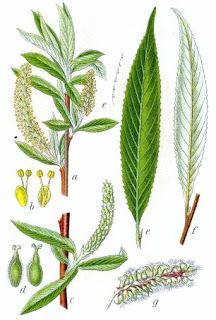
Willow can grow approximately 30m tall with a trunk diameter of approximately 1m. Willow has a grey brown bark which is rough in manner with deep fissures particularly in older trees, its branches that ascend, it’s crown is often irregular and leaning.. Being deciduous, it loses its leaves in winter, regaining them in spring. The shoots are green-grey-brown. The leaves are long, growing up to approximately 11cm in length and 0.5-1.5cm wide. The leaves are alternate and lanceolate in shape. Either side of the leaf are fine silky hairs, particularly the underside, giving the leaf a slightly paler green than other willows. When in leave the tree appears to droop. White willow is a dioecious tree meaning it has separate male and female trees, this is identifiable when the tree flowers at the same time it produces it’s spring leaves. The flowers are catkins, which are erect and cylindrical, initially a grey/silver colour the male flowers having a yellow anther and 2 stamen and being 5cm long the female flowers are a green colour and being 4cm long.
Parts used
Willow bark is the part most often used, this is harvested during growing season from the newer branches.
Forms and Dosage
Decoction 1-2g per day Tincture (1:5) 5-8ml Fluid extract (1:2) 20-50ml per week.
Please take with food due to the nature of salicylates on the digestive tract.
A compress can be made from powdered bark mixed in with a soothing balm or cream, this can be used to treat ulcers.
Therapeutic action
Analgesia, anti-inflammatory, antipyretic, antirheumatic and antiseptic.
Therapeutic applications
Willow is used mainly for the treatment of arthritis, alkalizing spondylitis, common cold, fever, gout, headaches, inflammation, influenza, migraines, joint and muscular inflammation, pain.
Active constituents
Phenolic, glycosides including salicylates - salicortin and salicin (highest in spring and summer in the tree), converts to salicytic acid – this is what Aspirin (synthetic acetylsalicylic acid) was made from.
Flavonoids: Prunin and tannins – reasearch has indicated the anti-inflammatory action of salicytic is minimal, it is thought these increase the anti-inflammatory effects.
Energetic
Astringent, bitter, cooling and drying – having a calming and stabilizing effect.
Cleears and cools damp heat in urogenital region – UTIs and discharges
Clears heat and infection in fever where vital defenses are weak
Signatures
Loves living in damp and wet conditions, linked with clearing pain from those with joint problems that worse with rain.
Symbology
Water – emotions
Linked with tree of water, the Underworld, birth, death, poetry, the moon, the Goddess and water deities including Artemis, Brigitia, Ceres, Isis, Kundalini, Lakshmi, Moon, Osiris, Persephone, Psyche.
Word - “Witch” (Wych) is derived from Willow, bosom made from Ash stake, birch twigs and willow binding.
Contradictions
Allergy to salicylate , breastfeeding or pregnant due to salicylate levels, GI problems.
Interactions
May interact with drugs such as warfarin which is a blood thinner however little evidence for this.
Caution with antiplatelet and anticoagulant drugs.
Possible beneficial with NSAIDs, leading to less use of medication.
© Vitae Essentia 2026